Settling Into the City: How American Students Build a Real Life Beyond the Campus Gates in Japan
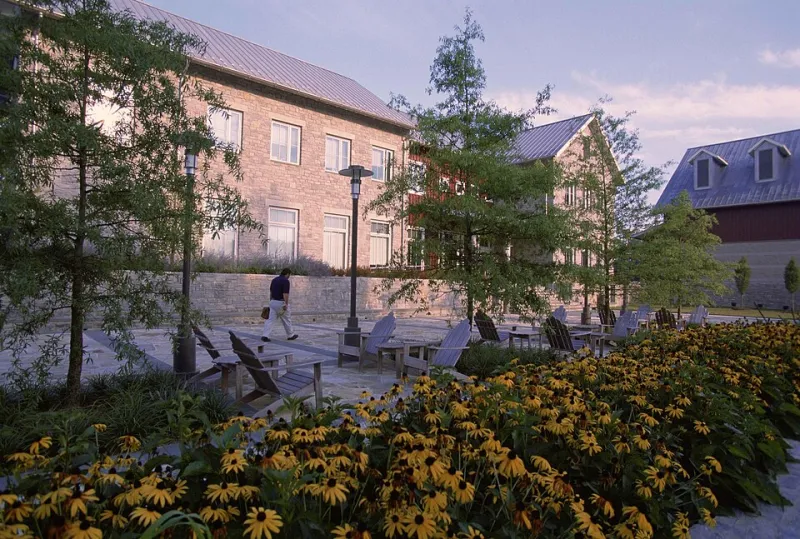
Photo: Ryan Hagerty, Public domain, via Wikimedia Commons
For many American students, the first weeks in Japan are defined by the comfortable predictability of campus life. Dormitory meals, orientation schedules, and the company of fellow international students create a soft landing that, while genuinely helpful, can also delay the deeper work of learning how to live in Japan. The real transformation begins when that scaffolding is removed — when you are standing at the entrance of a neighborhood supermarket, reading a handwritten sign, and realizing that no one around you speaks English.
This is not a crisis. It is, in fact, the beginning of something more valuable than any classroom experience Japan has to offer.
The Psychological Shift That Precedes the Practical One
Before addressing train lines, neighborhood associations, or grocery routines, it is worth acknowledging that moving from structured campus housing into an independent urban life in Japan is, at its core, a psychological transition. American students often arrive carrying an implicit assumption that competence in daily life will transfer across borders. It does not, at least not immediately.
In the United States, you know how to navigate a pharmacy, negotiate with a landlord, or ask for help at a hardware store without thinking twice. In Japan, each of these tasks requires conscious effort, linguistic preparation, and a tolerance for ambiguity that most Americans have not needed to develop at home. The students who adapt most successfully are those who reframe this discomfort not as inadequacy but as a learning environment — one that demands the same intellectual engagement they bring to their academic coursework.
Developing what might be called urban fluency in a Japanese city is a gradual process. It does not happen in a single confident moment. It accumulates through repeated small interactions: learning which convenience store stocks the items you need, understanding the unspoken etiquette of your apartment building, figuring out how to communicate a maintenance issue to a landlord who responds only in Japanese. Each of these moments, however minor they seem, builds the foundation of an independent life.
Navigating the Neighborhood as a Social Landscape
Japanese urban neighborhoods — whether a dense ward of Tokyo, a residential pocket of Osaka, or a quieter district of Fukuoka — operate according to social logics that are not immediately visible to outsiders. The local shotengai, or shopping street, is more than a commercial strip; it is a community institution. The neighborhood association, known as a chōnaikai, plays a role in civic life that has no direct American equivalent. Understanding these structures, even passively, changes how a student experiences the city.
American students who make an effort to shop locally, greet shop owners consistently, and participate in neighborhood rhythms — seasonal festivals, local cleanup initiatives, the quiet norms of trash disposal and bicycle parking — find that they are received with a warmth that more transient residents rarely experience. This is not about performing cultural sensitivity. It is about recognizing that integration into a Japanese city is earned incrementally through sustained, respectful presence.
Building a social circle outside the university requires a similar kind of patience. Japanese social culture tends toward depth over breadth, and friendships often develop through shared activities rather than casual conversation. Language exchange meetups, community sports clubs, volunteer organizations, and hobby groups — ikebana classes, photography clubs, hiking associations — are among the most reliable pathways to genuine connection with Japanese residents. These environments level the social playing field in ways that campus settings rarely do.
Managing Daily Life in a Non-English Environment
One of the most practically significant challenges of independent urban life in Japan is the consistent management of tasks that require Japanese-language competence. Unlike campus environments, which often provide multilingual support services, the broader city operates almost entirely in Japanese. This is true of government offices, medical clinics, utility providers, and local businesses alike.
The most effective strategy is not to wait until your Japanese is perfect before attempting these interactions. It is to develop a toolkit of approaches that allow you to function at your current level while continuing to improve. This includes maintaining a vocabulary of key phrases for common transactions, using translation applications as a bridge rather than a crutch, and — critically — learning to ask for clarification rather than nodding through confusion.
Many American students find that their Japanese improves most rapidly not in the classroom but in these everyday urban encounters. The stakes are low enough to allow for mistakes, yet real enough to motivate genuine effort. A conversation with a pharmacist about allergy medication, a negotiation with a postal worker about a missed delivery, a question asked of a neighbor about the local recycling schedule — these are the interactions that build functional language competence in ways that textbooks cannot replicate.
Constructing a Routine That Reflects Who You Are
One aspect of independent life in Japan that is rarely discussed in practical guides is the opportunity it provides for deliberate identity construction. Away from the social expectations and established routines of home, American students have an unusual degree of freedom to decide how they want to spend their time, what kind of community they want to belong to, and what values they want to organize their daily life around.
Some students find that Japan's culture of craft and discipline — evident in everything from the preparation of a bowl of ramen to the maintenance of a local shrine — inspires them to bring greater intentionality to their own habits. Others discover that the physical act of navigating a city on foot or by bicycle, without the car-dependency that defines much of American suburban life, reshapes their relationship to urban space in lasting ways.
The routines that emerge from this period — a preferred morning coffee shop, a running route along a river path, a weekly market visit, a standing appointment at a local gym — are not incidental. They are the architecture of a life. And the experience of building that architecture in a Japanese city, under conditions of genuine challenge, is one that tends to stay with students long after they have returned home.
What the City Ultimately Teaches
Living independently in a Japanese city is not simply a logistical exercise. It is an extended education in attentiveness — to cultural norms, to other people's expectations, to the gap between what you intend to communicate and what you actually convey. American students who commit to this experience fully, rather than retreating into the familiar comfort of international student networks, consistently report that it ranks among the most transformative periods of their lives.
The city, in this sense, becomes its own kind of classroom. And unlike any course you will formally enroll in, it offers no syllabus, no office hours, and no partial credit for effort. What it offers instead is something more durable: the demonstrated knowledge that you can build a meaningful life somewhere entirely unfamiliar — and that the skills required to do so travel with you wherever you go next.